
When you're buying a home in Dallas, negotiating a lower purchase price might seem like the obvious way to save money. But depending on your financing, asking the seller to contribute toward a mortgage rate buydown could actually make a bigger difference in your monthly payment.
So, should Dallas homebuyers negotiate a mortgage rate buydown or a price reduction?
The answer depends on how long you plan to own the home, how much cash you're bringing to closing, your mortgage terms, and what you're trying to accomplish financially.
In some situations, a seller-paid rate buydown can provide more immediate monthly savings than an equivalent price reduction. In others, a lower purchase price is the smarter long-term investment.
As a Dallas Realtor, I encourage buyers to compare both options before negotiating. The goal isn't simply to get the seller to give something up. It's to structure a purchase that makes financial sense for you.
Why Dallas Buyers Are Considering Mortgage Rate Buydowns in 2026
Mortgage rates continue to influence what buyers can comfortably afford.
According to Freddie Mac's Primary Mortgage Market Survey, the average 30-year fixed mortgage rate was 7.24% as of October 29, 2026.
At those rates, even relatively small changes to your mortgage terms can make a noticeable difference in your monthly housing expenses.
At the same time, buyers in many parts of Dallas have more opportunities to negotiate than they experienced during the most competitive years of the housing market.
That doesn't mean every seller is offering concessions. A beautifully renovated home in Lakewood, a well-priced property in the M Streets, or a particularly desirable home in the Park Cities can still attract significant interest.
However, a home that has been listed for several weeks, needs improvements, or faces competition from similar properties may present an opportunity to negotiate.
In our article, Is Now a Good Time to Buy a Home in Dallas?, we discuss why buyers should consider the entire purchasing opportunity instead of focusing exclusively on mortgage rates.
What Is a Mortgage Rate Buydown?
A mortgage rate buydown is a financing strategy that reduces the interest rate you pay or temporarily subsidizes your monthly mortgage payments.
The buydown may be funded by the buyer, seller, builder, or another permitted party.
There are two primary types.
Permanent Mortgage Rate Buydown
With a permanent buydown, money is paid at closing to secure a lower mortgage interest rate for the life of the loan.
This is typically accomplished by purchasing mortgage discount points.
For example, a buyer might qualify for a mortgage at 7.25% but have the opportunity to secure a 6.75% rate by paying additional upfront costs.
The exact cost depends on the lender, loan program, and market conditions. A half-percentage-point reduction does not have a standard price.
If the seller agrees to cover those costs, the buyer receives the benefit of a lower interest rate without personally paying for those discount points.
This can be especially attractive for buyers who expect to keep their mortgage for several years.
Temporary Mortgage Rate Buydown
A temporary buydown reduces the buyer's effective mortgage payment for a limited period.
One common structure is called a 2-1 buydown.
If the permanent mortgage rate is 7.25%, the buyer's effective payment schedule might look like this:
Year 1: Payments calculated using 5.25%
Year 2: Payments calculated using 6.25%
Year 3 and beyond: Payments calculated using the full 7.25%
The actual mortgage note rate remains 7.25%. Funds set aside at closing subsidize the difference in the payments during the first two years.
Importantly, buyers generally must qualify for the loan using the full mortgage rate, not the temporarily reduced payment.
A temporary buydown can create helpful breathing room during the first years of homeownership, but it does not permanently reduce the interest rate.
Dallas Example: $15,000 Price Reduction vs. Mortgage Rate Buydown
Let's look at an example using a $750,000 Dallas home.
Assume the buyer is making a 20% down payment and financing the purchase with a 30-year fixed-rate mortgage at 7.25%.
The original loan amount would be $600,000, with a monthly principal and interest payment of approximately $4,093.
Now imagine the seller is willing to negotiate $15,000 in value.
How should the buyer use it?
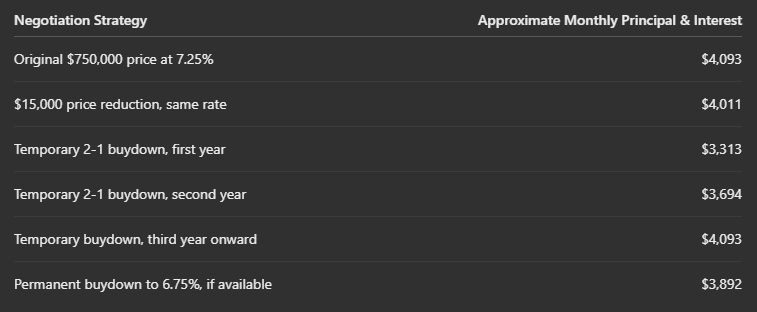
Illustrative calculations only. The permanent buydown assumes the lender can offer 6.75% using no more than the negotiated $15,000 credit. Actual rate pricing must be verified. Calculations exclude property taxes, insurance, HOA dues, mortgage insurance, and other ownership expenses.
Option 1: Negotiate a $15,000 Price Reduction
The purchase price decreases to $735,000.
With 20% down, the buyer's mortgage falls to $588,000.
Their monthly principal and interest payment decreases by approximately $82.
The buyer also needs $3,000 less for the down payment.
That might not sound dramatic on a monthly basis, but the buyer starts with a smaller mortgage balance and pays interest on less borrowed money.
Option 2: Request a Seller-Paid Temporary Buydown
Instead of lowering the sales price, the seller contributes toward a 2-1 temporary mortgage buydown.
Using the original $600,000 loan and a 7.25% note rate, this example would require approximately $14,143 in payment subsidies over the first two years.
The buyer's payment would decrease by approximately $780 per month in the first year and $399 per month in the second year.
Those are significant short-term differences.
However, when the temporary buydown expires, the payment returns to approximately $4,093 per month.
The buyer still owes the mortgage based on the original $600,000 loan.
Option 3: Negotiate a Permanent Rate Buydown
Suppose a lender confirms that a $15,000 seller contribution can cover the discount points required to reduce the rate from 7.25% to 6.75%.
On a $600,000 mortgage, the principal and interest payment would decrease by approximately $201 per month.
Unlike a temporary buydown, the lower rate would remain for as long as the buyer keeps that fixed-rate loan.
This is where the numbers become interesting.
For a buyer focused on monthly affordability, a permanent rate buydown may offer greater payment relief than the same dollar amount applied toward a price reduction.
But that doesn't automatically make it the better financial choice.
The buyer still needs to consider the remaining loan balance, cash required at closing, likely time in the home, refinancing plans, and the property's actual value.
When Is a Mortgage Rate Buydown Better Than a Price Reduction?
A mortgage rate buydown may make sense when your primary concern is the monthly payment rather than the purchase price.
Consider a buyer purchasing a home in Lake Highlands who has a comfortable down payment and significant savings remaining after closing.
They love the house, believe the purchase price is supported by comparable sales, and plan to stay for the foreseeable future.
If the seller is open to concessions, applying those funds toward a permanent rate buydown could make their monthly budget more comfortable.
That may be more beneficial to them than negotiating a modest reduction in the sales price.
Rate buydowns can also be attractive when buyers want to preserve their own cash for improvements, furnishings, or the unexpected expenses that often accompany homeownership.
But I would never recommend making a purchase work financially only because the first year's temporarily reduced payment looks affordable.
Your budget needs to support the full mortgage payment, too.
When Is a Price Reduction the Better Choice?
There are several situations where I would lean toward negotiating the purchase price instead.
First, if the home is overpriced relative to comparable sales, correcting the purchase price should be the priority.
A seller-paid buydown doesn't change what the property is worth.
Second, buyers who may sell or refinance relatively soon should carefully evaluate the value of a permanent rate buydown. The benefits of prepaid discount points may be reduced if the mortgage is paid off early.
Third, buyers concerned about their long-term debt may prefer starting with a smaller loan balance.
A lower purchase price can also reduce the required down payment when the buyer is financing a fixed percentage of the purchase price.
In Dallas, I also encourage buyers to consider the property's condition and future resale potential.
For example, a charming older home near White Rock Lake may need improvements to major systems, drainage, or foundation-related items.
In that situation, I might prioritize a price reduction or another negotiated solution that addresses the property's overall value rather than focusing exclusively on the mortgage payment.
It's worth remembering that a lower purchase price does not automatically produce a matching reduction in Dallas property taxes. Property taxes are determined through the local appraisal and taxation process, not simply by applying a tax rate to the contract price.
How Mortgage Rate Buydown Negotiations Differ Across Dallas Neighborhoods
Dallas isn't one uniform housing market, and negotiation strategies should reflect that.
Lakewood and the M Streets
Buyers pursuing historic properties or beautifully updated homes often place significant value on location, architecture, and long-term neighborhood appeal.
For a competitive property in Lakewood, asking for a major concession may not be realistic.
But when a property needs work or has been sitting longer than comparable listings, seller contributions may become part of the conversation.
Lake Highlands
Lake Highlands offers a wide range of properties, from original ranch-style homes to extensively renovated residences and newer construction.
Because the housing stock varies so much, the best negotiation strategy often depends on property condition, competing inventory, and seller motivation.
A mortgage rate buydown might be appealing on a move-in-ready home, while a buyer purchasing a home that needs renovations may place more value on a price adjustment or closing-cost assistance.
Preston Hollow, Devonshire, Bluffview, and the Park Cities
At higher purchase prices, even small interest-rate changes can have a meaningful impact on monthly payments.
However, buyers in these markets may use jumbo or other financing programs with different qualification requirements, pricing, and seller-contribution rules.
For luxury purchases, the financial comparison should be based on the specific loan proposal, not a generic online mortgage calculator.
The common thread across these neighborhoods is that the right negotiating strategy begins with understanding the property and the buyer's financial priorities.
Can Dallas Sellers Pay for a Buyer's Mortgage Rate Buydown?
Yes, sellers can often contribute toward a buyer's mortgage rate buydown, provided the arrangement is permitted by the loan program and lender.
These contributions are commonly negotiated as seller concessions or seller-paid closing costs.
However, there are limitations.
For example, conventional loans purchased by Fannie Mae have seller-contribution limits that vary based on occupancy and loan-to-value ratio.
Eligible primary residence transactions may have limits of 3%, 6%, or 9%, depending on the amount financed, while investment properties have different requirements.
Seller contributions generally cannot be used to satisfy the buyer's required down payment.
There may also be restrictions on which charges qualify, how credits are documented, and whether unused credits can be applied to other expenses.
Before making an offer, the lender should confirm exactly how much seller assistance is permitted and what benefit it can provide.
For buyers trying to preserve cash, our guide to closing costs when buying a home in Dallas explains additional expenses that may be part of the negotiation.
How I Recommend Dallas Buyers Compare Their Options
Before deciding whether to negotiate a lower price or a seller-funded rate buydown, I recommend having your lender prepare side-by-side estimates using the same property and financing assumptions.
Compare the purchase price, down payment, closing costs, monthly principal and interest, total monthly housing payment, and projected loan balance.
Then look at what happens if you keep the loan for three years, five years, and ten years.
For a permanent buydown, ask the lender to calculate how long it would take for monthly savings to offset the cost of the discount points.
For a temporary buydown, confirm the payment after the subsidy expires and what happens to any unused buydown funds if you refinance or sell early.
I also encourage buyers to consider what the seller is trying to accomplish.
Some sellers care most about the final contract price. Others are more concerned with the amount they'll receive at closing, timing, or certainty that the transaction will close.
A thoughtful offer can address both sides' priorities.
The strongest negotiation isn't always the one with the largest price reduction. It's the one that creates the best overall outcome.
Why Work with Mysti Stewart and the Mysti Stewart Group?
Buying a home involves much more than agreeing on a price.
The financing structure, property condition, neighborhood, future resale potential, and contract terms all influence whether you're making a smart investment.
At the Mysti Stewart Group at Compass, we help buyers throughout Dallas understand their options and negotiate with a strategy tailored to the property and their financial goals.
Our team works extensively in Lakewood, Lake Highlands, East Dallas, the M Streets, Preston Hollow, Devonshire, Bluffview, Highland Park, and University Park.
With more than two decades of Dallas real estate experience, I know how important it is to look beyond the obvious numbers.
We work alongside your lender to evaluate financing scenarios, assess property value, understand seller motivation, and structure offers that make sense for your circumstances.
Our approach is rooted in thoughtful guidance, strong relationships, and the belief that exceptional service should extend well beyond the closing table.
Final Thoughts
Should Dallas buyers ask for a mortgage rate buydown instead of a price reduction?
Sometimes, absolutely. But not without comparing the numbers.
A temporary buydown can provide substantial short-term payment relief. A permanent buydown may reduce monthly expenses for years. A price reduction lowers the amount you're paying for the property and the debt you're taking on.
Each option has value.
What matters most is making sure your negotiation supports your long-term financial goals, not simply creating the most attractive monthly payment on paper.
If you're buying a home in Dallas and want to understand how to structure the strongest offer, the Mysti Stewart Group would love to help you evaluate your options.
Frequently Asked Questions
Is it better to buy down your mortgage rate or lower the home price?
A mortgage rate buydown may provide greater monthly payment savings, particularly when a lender offers favorable pricing for permanent discount points. A price reduction decreases the purchase price and typically lowers the starting mortgage balance. The better choice depends on your financing, expected ownership timeline, and financial goals.
How much does it cost to buy down a mortgage rate by 1%?
There is no universal cost to reduce a mortgage interest rate by one percentage point. One discount point generally costs 1% of the loan amount, but one point does not necessarily reduce the interest rate by one percentage point. Your lender must provide a current quote showing the cost and resulting rate.
Can I ask a Dallas home seller to pay for a 2-1 buydown?
Yes, if the seller agrees and the lender and loan program allow it. The seller's contribution can fund the temporary payment subsidy through closing. Buyers should confirm the full payment schedule and qualification requirements before submitting the offer.
What happens if I refinance after receiving a mortgage rate buydown?
With a permanent buydown, refinancing replaces the existing mortgage, so the original discounted rate no longer applies. With a temporary buydown, any remaining subsidy funds are handled according to the buydown agreement and applicable servicing rules. They may be credited toward payoff or otherwise distributed as permitted by the agreement.
Are mortgage rate buydowns worth negotiating in Dallas in 2026?
They can be, particularly when mortgage rates make monthly affordability a concern and a seller is willing to provide concessions. The decision should be based on actual lender quotes, comparable home sales, the property's condition, and the buyer's expected time in the home. A buydown is one negotiating tool, not automatically the best one.