
Highland Park vs. University Park: What’s the Difference for Home Buyers?
If you're considering buying a home in Highland Park or University Park, you may be wondering whether there is really much difference between the two.
Both communities are part of the Park Cities, two established and highly desirable residential areas surrounded by Dallas. They share a central location, beautiful homes, mature trees, neighborhood parks, and access to Highland Park Independent School District for qualifying addresses.
But Highland Park and University Park are not interchangeable.
Highland Park is often associated with estate-style properties, distinctive historic architecture, winding streets, and a more formal residential setting. University Park offers a mix of traditional homes, renovated properties, and luxury new construction, with much of its lifestyle centered around neighborhood schools, Southern Methodist University, and Snider Plaza.
The differences become especially important when comparing home prices, lot sizes, walkability, schools, property taxes, and the character of individual streets.
For buyers deciding between these two Dallas communities, understanding those distinctions can make finding the right home considerably easier.
Are Highland Park and University Park the Same Neighborhood?
No. Highland Park and University Park are two separate municipalities that together make up the Park Cities.
Highland Park is an incorporated town, while University Park is an incorporated city. Both are located within Dallas County and surrounded by the City of Dallas.
Each municipality has its own local government, police department, public services, zoning regulations, and parks.
Highland Park generally occupies the southern portion of the Park Cities, closer to Turtle Creek, Knox Street, and parts of central Dallas. University Park extends farther north and includes SMU, Snider Plaza, and established residential streets near Lovers Lane and Northwest Highway.
Although the two communities share many characteristics, their streets, housing patterns, and everyday routines can feel surprisingly different.
Our Park Cities neighborhood guide offers additional context on the location, amenities, and lifestyle that make this part of Dallas appealing to home buyers.
Highland Park vs. University Park at a Glance
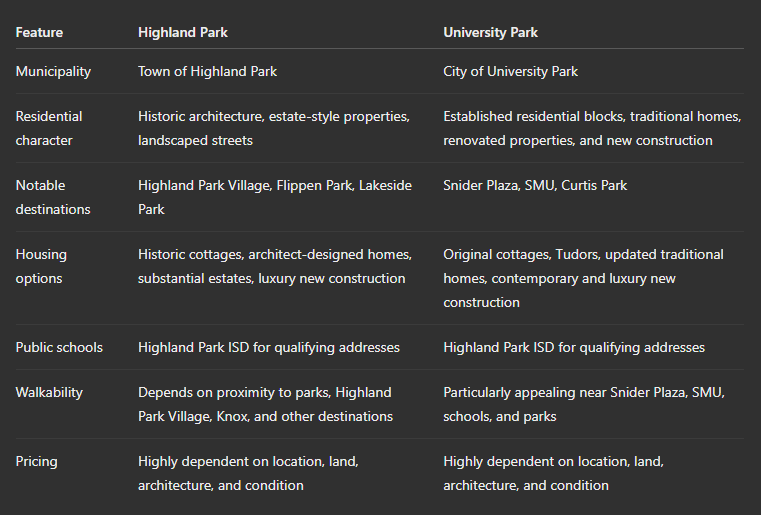
These are general characteristics, not hard rules. There are intimate residential streets in Highland Park and significant estate properties in University Park.
The home and its exact location ultimately matter more than the neighborhood label.
What Is It Like to Live in Highland Park?
Highland Park has an established residential character that is difficult to replicate elsewhere in Dallas.
Certain streets are known for substantial homes, mature trees, winding roads, carefully maintained landscaping, and architecture that reflects several generations of Dallas history.
The neighborhood includes beautiful Tudor residences, Georgian and Colonial homes, Mediterranean architecture, French-inspired estates, and modern luxury construction.
One of Highland Park's defining features is the relationship between its homes and the surrounding landscape.
In areas near Turtle Creek, Lakeside Park, and Prather Park, the winding streets, creek corridors, and established trees contribute to a setting that can feel noticeably different from Dallas neighborhoods laid out on more traditional street grids.
Flippen Park is another distinctive Highland Park landmark. Its landscaped grounds, fountain, reflecting pool, and gazebo create a small but memorable neighborhood gathering place.
Highland Park Village provides a major shopping and dining destination, while nearby Knox Street offers additional restaurants, retail, and access to the Katy Trail.
For some buyers, Highland Park's appeal is the ability to live in an architecturally distinctive home on an established street while remaining close to central Dallas.
Others are drawn to larger lots, privacy, traditional architecture, or the opportunity to purchase and renovate a historic property.
The important distinction is that Highland Park includes several different residential environments.
A home close to Highland Park Village may offer a different everyday experience from a property near Turtle Creek or a quieter interior street.
Our Highland Park real estate and neighborhood guide provides a closer look at the area's architecture, parks, schools, housing considerations, and market characteristics.
What Is It Like to Live in University Park?
University Park shares Highland Park's central location and established residential appeal, but its community layout and lifestyle have some distinct characteristics.
One of the most recognizable is the relationship between residential neighborhoods, schools, parks, and Southern Methodist University.
SMU contributes to the community's identity through its campus, athletic events, performances, and cultural activities.
Nearby Snider Plaza is another major part of University Park life.
Established in 1927, Snider Plaza remains a neighborhood commercial district with restaurants, boutiques, services, and places residents visit regularly.
For buyers interested in walking to coffee, grabbing dinner close to home, or having shops and everyday services nearby, certain University Park streets offer an appealing combination of residential living and neighborhood convenience.
You can read more about this in our article, What Is Snider Plaza and Why Does It Matter to University Park Homebuyers?.
University Park also includes established parks, neighborhood recreation opportunities, and residential areas with a wide range of home styles.
You'll find original cottages, classic brick homes, Tudors, renovated traditional properties, and newer custom construction.
Some streets have smaller original homes alongside much larger rebuilt properties. Others have a more consistent architectural character.
Proximity to SMU and Snider Plaza can bring additional activity, particularly around university events, school schedules, and popular shopping areas.
For some buyers, that activity is part of the attraction. Others prefer a quieter University Park block farther from major destinations.
That is why it is important to evaluate the specific location rather than assuming every University Park address offers the same experience.
Is Highland Park More Expensive Than University Park?
This is one of the most common questions buyers ask, and the answer is more complicated than a simple neighborhood average.
Both Highland Park and University Park are established luxury real estate markets with limited land availability and substantial demand for well-located properties.
Highland Park includes some significant estate-style homes and substantial residential lots, which can influence its overall pricing.
University Park also has expensive luxury properties, substantial new construction, and highly desirable residential locations.
However, comparing average home prices between the two can be misleading.
A month with several large Highland Park estate sales may create a very different picture from a month with smaller home sales. The same is true for University Park when its sales mix includes luxury new construction or older homes purchased primarily for their land.
When evaluating the price of a specific home, I would pay close attention to the lot dimensions, location on the block, architectural quality, floor plan, renovation history, garage and parking arrangements, and nearby comparable sales.
For example, an extensively renovated University Park home on an excellent interior lot may be priced above an older Highland Park property requiring substantial improvements.
The opposite can also be true.
Neither Highland Park nor University Park is automatically the more affordable choice.
The more useful question is what type of home, lot, location, and condition your budget can purchase in each community.
Are the Schools Different in Highland Park and University Park?
For buyers considering public schools, this is an important area of overlap.
Most residential properties in Highland Park and University Park are served by Highland Park Independent School District, commonly known as HPISD.
The district also includes certain properties within the City of Dallas.
However, buyers should not assume that every property with a Highland Park or University Park mailing address has the same school assignment.
Elementary attendance zones can differ by address. HPISD includes campuses such as Armstrong, Bradfield, Hyer, Michael M. Boone, and University Park Elementary.
Students subsequently attend the district's intermediate, middle, and high school campuses according to applicable enrollment and attendance policies.
Before making an offer on a property where public-school eligibility matters, verify the exact address through the Highland Park ISD enrollment and School Site Locator resources.
A ZIP code, listing description, or real estate website is not a substitute for direct district verification.
For some households, proximity to a particular elementary school may influence their preferred blocks. Others may care more about the commute to work, access to extracurricular activities, or nearby private-school options.
The key point is that Highland Park and University Park generally share the same public-school district, so choosing between the two is not necessarily a decision between different school systems.
Which Neighborhood Has Better Walkability?
Both communities offer walkable residential streets and convenient access to parks, but the experience depends heavily on the exact property.
Walkability in Highland Park
Homes near Highland Park Village may offer convenient access to shopping and dining.
Properties closer to Lakeside Park, Prather Park, or Flippen Park provide opportunities to enjoy neighborhood green space on foot.
Some eastern Highland Park locations also have convenient access to Knox Street and the Katy Trail.
However, a substantial Highland Park estate on a quieter residential street may be better suited to buyers who prefer privacy and do not expect to walk to restaurants or shopping.
Walkability in University Park
University Park offers some particularly appealing walking opportunities around Snider Plaza, SMU, schools, and neighborhood parks.
For buyers who want to walk to a restaurant, pick up coffee, or reach a nearby park, those locations can be attractive.
But not every University Park property is within a comfortable walking distance of Snider Plaza.
A home closer to Northwest Highway or another part of University Park may have a very different relationship with restaurants, shopping, and schools.
When walkability matters, I recommend evaluating the actual route from the property.
Distance alone does not always tell you whether the walk is convenient, comfortable, or something you would realistically do several times a week.
Do Highland Park and University Park Have Different Property Taxes?
Yes, their tax structures can differ because they are separate municipalities.
Even when two homes share the same school district, they may have different municipal tax rates and other applicable taxing jurisdictions.
The total property tax obligation also depends on the property's taxable value, exemptions, and current tax rates.
When comparing homes in Highland Park and University Park, buyers should look beyond the seller's current annual tax bill.
An existing homeowner may benefit from a homestead exemption or appraisal limitation that does not transfer to a new owner in the same way.
That means the seller's tax history may not accurately represent what you will pay after purchasing the property.
For a better understanding of how these costs affect your budget, read What Are Property Taxes Like When Buying a Home in Dallas?.
Before making an offer, confirm the property's taxing jurisdictions, current applicable rates, and a realistic estimate of future taxes.
I also encourage buyers to compare insurance, utilities, landscaping, pool maintenance, and anticipated repairs.
A home that costs less upfront is not necessarily less expensive to own.
What Should Buyers Know About Older Homes and New Construction?
Both communities have beautiful older homes, extensively renovated residences, and significant new construction.
A historic Highland Park property may offer beautiful architectural details, established landscaping, and a desirable lot.
A renovated University Park home may provide a more modern floor plan while retaining some original character.
New construction in either community can offer contemporary layouts, energy-efficient systems, larger closets, home offices, and outdoor living spaces.
But newer does not automatically mean better, and older does not automatically mean problematic.
For established homes, pay particular attention to foundations, plumbing, electrical systems, roofs, drainage, windows, and the quality of previous renovations.
Dallas soil conditions and decades of property improvements make foundation and drainage evaluations especially important.
Our article on how to evaluate drainage before buying an older Dallas home explains what buyers should investigate before their option period expires.
For buyers considering a teardown, addition, or major renovation, another important consideration is municipal regulation.
Highland Park and University Park have separate requirements governing construction, setbacks, permitting, and other property improvements.
Before purchasing a home based on its future renovation potential, confirm what the applicable municipality will allow.
A beautiful lot does not necessarily mean every addition, pool, garage, or new-home design will be possible.
Which Location Is Better for Commuting Around Dallas?
Both Highland Park and University Park offer excellent access to central Dallas compared with many farther-out suburban locations.
Highland Park can be particularly convenient for buyers whose routines involve Uptown, Turtle Creek, Knox Street, Downtown Dallas, and nearby business districts.
University Park may appeal to buyers spending considerable time near SMU, Preston Center, North Dallas, or areas farther north along the Dallas North Tollway.
However, these are general location tendencies.
A home near a major intersection may offer faster access to a commuting route but experience more traffic or noise.
A property on a quiet interior street may provide a more peaceful setting but require additional travel time to reach major roads.
I always encourage buyers to test the commute from an actual property during the hours they would normally travel.
A neighborhood that looks ideal on a map needs to work with your everyday schedule.
Is Highland Park or University Park Better for Long-Term Resale Value?
Both communities have characteristics that can support long-term buyer interest, including central locations, established neighborhoods, architectural appeal, and limited geographic boundaries.
But buying in the Park Cities does not automatically guarantee appreciation or a strong resale outcome.
Future resale value depends on many property-specific factors.
A beautifully renovated home on a desirable interior block may appeal to buyers differently from a larger property along a busier road.
An unusually narrow lot, awkward floor plan, limited parking, expensive maintenance requirements, or poorly executed renovation can affect future marketability in either community.
This is one reason I believe buyers should think about resale before they purchase, not just when they eventually decide to sell.
Consider how the home's location, layout, condition, architectural style, and outdoor space might appeal to the next buyer.
The goal is to purchase a property that works well for your own life while understanding the features that may support its future market position.
So, Should You Buy in Highland Park or University Park?
If you're deciding between these two communities, I would start with the features you value most rather than choosing based on the prestige of a particular address.
Highland Park may be the better fit if you are particularly drawn to substantial estate properties, historic architecture, mature landscaping, winding residential streets, and proximity to Highland Park Village, Turtle Creek, or Knox Street.
University Park may be the better fit if you want a mix of traditional homes and newer construction, convenient access to SMU, and opportunities to live near neighborhood shopping, restaurants, parks, and schools.
Both communities offer homes that fall outside those general descriptions.
A buyer who initially prefers Highland Park may find that a particular University Park property has the better floor plan, lot, or walkability.
Someone focused on University Park may discover a Highland Park home with exceptional architecture and a location that works beautifully for their routine.
If you're still comparing other established luxury neighborhoods, our article Preston Hollow vs. the Park Cities: Which Is Better for Your Dallas Home Search? provides another useful perspective on land, privacy, location, and neighborhood lifestyle.
Ultimately, I would rather see a buyer choose the right house on the right street than purchase a home simply because it carries a particular neighborhood name.
Why Work with Mysti Stewart and the Mysti Stewart Group?
Highland Park and University Park are two markets where local knowledge can make a meaningful difference.
Homes that look similar online may have very different values because of their lots, blocks, renovation histories, architecture, school assignments, or surrounding properties.
A beautifully updated kitchen does not tell you whether the renovation was completed thoughtfully.
A large lot does not automatically mean it can accommodate the improvements you have in mind.
And a home with an impressive address is not necessarily the strongest purchase for your needs or budget.
Mysti Stewart and the Mysti Stewart Group help buyers look beyond the listing photographs to understand the complete property.
Our approach includes neighborhood comparisons, property-specific pricing analysis, renovation and maintenance considerations, inspections, offer strategy, negotiations, and future resale potential.
For buyers relocating to Dallas, we also help translate neighborhood differences into practical decisions about daily routines, commuting, schools when relevant, and lifestyle preferences.
We work throughout Highland Park, University Park, Preston Hollow, Lakewood, East Dallas, Lake Highlands, Devonshire, Bluffview, and surrounding Dallas neighborhoods.
Our goal is to help you find a home that makes sense financially, functions well for your lifestyle, and feels like the right place for your next chapter.
Final Thoughts
Highland Park and University Park share many of the qualities that make the Park Cities one of Dallas's most established residential destinations.
Both offer distinctive architecture, neighborhood parks, central locations, and access to Highland Park ISD for qualifying properties.
The differences are found in their residential character, housing options, neighborhood destinations, municipal boundaries, and the experience of living on a particular street.
Highland Park may appeal more strongly to buyers seeking estate-style homes, established architecture, and proximity to Highland Park Village and Turtle Creek.
University Park may attract buyers who value access to Snider Plaza, SMU, neighborhood parks, and a variety of renovated and newly constructed homes.
Neither is universally better.
The strongest home-buying decisions come from understanding the individual property, the surrounding neighborhood, and how both fit your long-term plans.
If you're considering a home in Highland Park or University Park, Mysti Stewart and the Mysti Stewart Group can help you compare available properties, understand market value, and identify the location that best matches your priorities.
Frequently Asked Questions
Is Highland Park more expensive than University Park?
Not necessarily. Both communities include substantial luxury properties, and prices vary significantly by street, lot size, architecture, condition, and renovation quality. Highland Park has notable estate-style properties, while University Park also offers high-end luxury homes and new construction. Comparing specific properties and recent sales provides a more accurate answer than comparing neighborhood-wide averages.
Are Highland Park and University Park in the same school district?
Most homes in both municipalities are served by Highland Park Independent School District. However, district eligibility and elementary attendance assignments should be verified for the exact property through HPISD before purchasing.
Is Highland Park part of Dallas?
Highland Park is a separate incorporated town surrounded by Dallas. University Park is also a separate municipality. Together, the two communities are known as the Park Cities. Both are located in Dallas County.
Is University Park more walkable than Highland Park?
Certain University Park locations near Snider Plaza, SMU, and neighborhood parks offer convenient walking access to everyday destinations. Highland Park also has walkable locations near Highland Park Village, parks, and nearby Knox Street. Walkability should be evaluated from the specific home rather than assumed based on the municipality.
Do Highland Park and University Park have the same property taxes?
Not necessarily. Highland Park and University Park have separate municipal governments and may have different municipal tax rates. The total tax obligation depends on the property's applicable taxing jurisdictions, taxable value, exemptions, and current rates. Buyers should estimate their own future taxes rather than relying solely on the seller's existing tax bill.