
How Much Does It Cost to Sell a Home in Dallas?
Selling a home in Dallas usually costs about 7% to 10% of the sale price, depending on the property, pricing strategy, preparation needs, buyer negotiations, and whether the seller offers buyer concessions. On a $750,000 Dallas home, that means many sellers should plan for roughly $52,500 to $75,000 in total selling costs before mortgage payoff.
The biggest expenses are usually real estate compensation, title policy, prorated property taxes, repairs or preparation, and any concessions negotiated with the buyer.
The Main Costs Dallas Sellers Should Expect
Real Estate Agent Compensation
Real estate commissions are negotiable. In Dallas, many sellers still budget around 5% to 6% of the sale price for total brokerage compensation, although the exact amount depends on the listing agreement, buyer demand, and whether the seller chooses to offer any buyer-agent compensation or closing cost assistance.
Since the 2024 National Association of Realtors settlement, sellers are no longer required to offer buyer broker compensation through the MLS, and buyer-agent compensation is handled with more transparency and negotiation. Buyers are also required to have written agreements with their agents before touring homes.
For Dallas sellers, the practical takeaway is simple: commission strategy is now part of the pricing and negotiation strategy. In neighborhoods like Lakewood, the M Streets, Lake Highlands, Preston Hollow, and the Park Cities, the right approach depends on price point, buyer pool, property condition, and how competitive the listing is.
Internal link suggestion: Link to a seller strategy article such as “Should Dallas Sellers Offer Buyer Agent Compensation?” or a Dallas home-selling guide.
Owner’s Title Policy
In Texas, the owner’s title policy is often paid by the seller, although this is negotiable in the contract. Texas title insurance rates are set by the Texas Department of Insurance, which means title companies must charge the same premium rate for the policy itself.
As a rough estimate, the owner’s title policy may cost around 0.6% to 0.9% of the sale price, with the percentage generally lower on higher-priced homes. For a $750,000 sale, a seller might expect this cost to land in the several-thousand-dollar range.
This matters in Dallas because higher-value homes in Lakewood, Highland Park, University Park, Bluffview, Devonshire, and Preston Hollow can have meaningful title policy costs that sellers should factor into their net sheet early.
Prorated Property Taxes
Texas property taxes are paid in arrears, so Dallas sellers typically credit the buyer for the portion of the year they owned the home up to the closing date. The exact amount depends on the home’s taxable value, exemptions, tax rate, and closing date.
The Texas Comptroller notes that Texas does not have a state property tax. Property taxes are set and administered locally by taxing units such as cities, counties, school districts, hospital districts, and community college districts. Dallas Central Appraisal District publishes local tax rate information for Dallas County taxing units.
For many Dallas homeowners, prorated taxes can be one of the more noticeable closing line items, especially if the home has appreciated significantly or is located in a high-value area.
Repairs, Prep, and Make-Ready Costs
This is where Dallas sellers have the most variation. A well-maintained home in Lakewood or the M Streets may only need cleaning, landscaping, paint touch-ups, and staging. An older East Dallas cottage, Lake Highlands ranch, or Preston Hollow estate may need more preparation before going live.
Common pre-listing costs include:
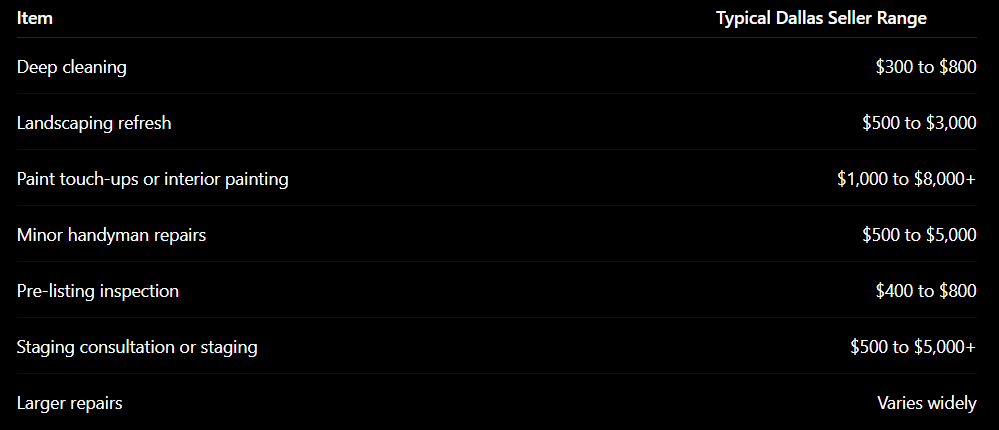
The key is not to spend blindly. In Dallas, preparation should be tied to the buyer profile. A move-in-ready Lakewood Tudor, a polished M Streets cottage, or a stylish Devonshire home may benefit from presentation upgrades. A property likely to attract renovation-minded buyers may need a different strategy.
Internal link suggestion: Link to “What to Fix Before Selling a Home in Dallas” or “How to Prepare a Lakewood Home for Sale.”
Buyer Concessions
Buyer concessions are another major variable. A seller may agree to contribute toward the buyer’s closing costs, rate buydown, repairs, or other negotiated items.
In a strong seller’s market, concessions may be limited. In a more balanced Dallas market, they can become part of the negotiation, especially if the buyer is stretching on affordability or inspection items. Seller concessions are not automatically bad. Sometimes a smart concession preserves the sales price, keeps the deal together, and protects the seller’s larger goal.
Escrow, Recording, HOA, and Miscellaneous Closing Fees
Dallas sellers may also see smaller closing costs such as escrow fees, document preparation, courier fees, wire fees, recording-related charges, HOA resale documents, HOA transfer fees, home warranty costs if negotiated, and payoff or release fees for an existing mortgage.
These costs vary by title company, property type, HOA, and contract terms. A condo, townhome, or HOA property may have higher association-related fees than a detached home without an HOA.
Does Texas Have a Real Estate Transfer Tax?
No. Texas does not have a real estate transfer tax on the sale of a home. The Texas Constitution prohibits a transfer tax on transactions that convey fee simple title to real property.
This is helpful for Dallas sellers because many other states charge transfer taxes or documentary stamp taxes at closing.
Example: Estimated Cost to Sell a $750,000 Home in Dallas
Here is a sample estimate for a Dallas seller. Actual numbers will depend on the contract, closing date, mortgage payoff, title charges, tax proration, and preparation plan.
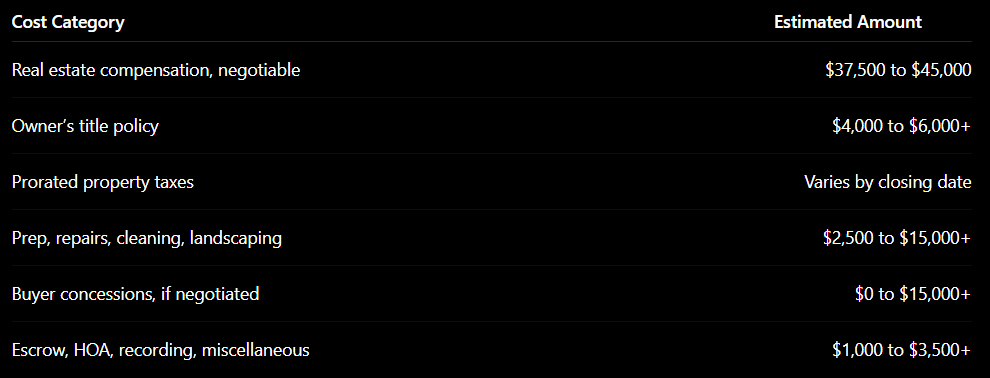
For many Dallas sellers, a realistic total range is 7% to 10% of the sale price, not including mortgage payoff.
Why Dallas Neighborhoods Matter When Estimating Seller Costs
Selling costs are not the same in every Dallas neighborhood because buyer expectations are different.
In Lakewood, buyers often care about historic charm, updated kitchens, outdoor living, and proximity to White Rock Lake. In the M Streets, presentation and architectural character can heavily influence buyer response. In Lake Highlands, family functionality, schools, updates, and floor plan matter. In Preston Hollow, Highland Park, University Park, Bluffview, and Devonshire, luxury buyers expect a higher level of preparation, marketing, photography, and pricing precision.
The best net result is not always created by spending the least. It comes from spending strategically, pricing correctly, and negotiating with a clear understanding of the local buyer pool.
How to Reduce the Cost of Selling Without Hurting Your Net
The goal is not simply to cut costs. The goal is to protect your bottom line.
A Dallas seller can often improve net proceeds by getting a pre-listing strategy before making repairs, pricing accurately from the beginning, preparing the home for the most likely buyer, understanding when concessions are worth it, and comparing a realistic net sheet before accepting an offer.
A lower-cost approach that leads to a lower sales price, longer days on market, or a difficult inspection negotiation may cost more in the end.
Why Work with Mysti Stewart and the Mysti Stewart Group?
Selling a home in Dallas is not just about listing it on the market. It is about knowing what buyers value, where to invest before listing, how to position the home, and how to negotiate the contract so the seller’s net is protected.
Mysti Stewart and the Mysti Stewart Group bring neighborhood-level experience across Lakewood, East Dallas, the M Streets, Lake Highlands, Highland Park, University Park, Preston Hollow, Devonshire, Bluffview, Forest Hills, Casa Linda, and surrounding Dallas neighborhoods. That local knowledge matters when deciding which improvements are worth making, how to price against current competition, and how to respond to inspection requests, concessions, and buyer financing terms.
For sellers, the right guidance can mean fewer surprises, stronger positioning, and a clearer understanding of what they will actually walk away with after closing.
Final Thoughts
The cost to sell a home in Dallas usually falls between 7% and 10% of the sale price, but the exact number depends on the home, the neighborhood, the contract, and the seller’s strategy. Real estate compensation, title policy, tax proration, preparation, repairs, and concessions are the biggest items to understand before going on the market.
Before making repairs or setting a price, Dallas sellers should request a detailed net sheet. That is the best way to see estimated proceeds, compare likely scenarios, and make confident decisions before listing.
FAQs
How much does it cost to sell a house in Dallas?
Most Dallas sellers should budget around 7% to 10% of the sale price, not including mortgage payoff. This typically includes agent compensation, title policy, tax proration, preparation, repairs, concessions, and closing fees.
Who pays the title policy in Texas?
In many Texas transactions, the seller pays for the owner’s title policy, but it is negotiable in the contract. Texas title insurance premium rates are set by the Texas Department of Insurance.
Do Dallas sellers pay property taxes at closing?
Dallas sellers usually give the buyer a credit for prorated property taxes through the closing date because Texas property taxes are paid in arrears. The final amount depends on the home’s taxable value, exemptions, tax rate, and closing date.
Do sellers still pay the buyer’s agent in Dallas?
Seller-paid buyer-agent compensation is no longer required through the MLS and is negotiable. Some sellers may still choose to offer compensation or concessions as part of their strategy, depending on the home, price point, and buyer pool.
What is the biggest cost when selling a Dallas home?
The largest cost is usually real estate compensation, followed by title policy, property tax proration, repairs or make-ready costs, and any buyer concessions negotiated in the contract.