
M Streets vs. Lakewood: Which East Dallas Neighborhood Fits Your Life?
If you are deciding between the M Streets and Lakewood, the choice usually comes down to how you want everyday life in East Dallas to feel.
The M Streets tends to appeal to buyers who love historic Tudors, smaller-scale neighborhood streets, sidewalks, and being close to the restaurants and energy of Lower Greenville. Lakewood often attracts buyers who want architectural character too, but place more emphasis on White Rock Lake, outdoor routines, mature trees, and a wider variety of homes and lot configurations.
Neither neighborhood is automatically the better choice. They are close enough that many buyers consider both, yet different enough that most people develop a preference once they spend time driving the streets, walking the neighborhood, and comparing actual homes.
If both are on your list, here is how I would think about the decision.
M Streets vs. Lakewood at a Glance
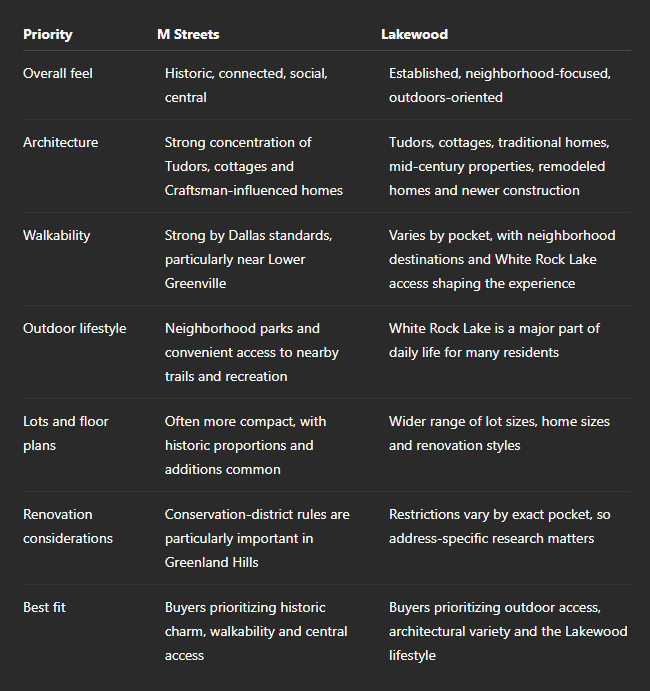
Those are useful starting points, but East Dallas real estate is very property-specific. Two houses a few blocks apart can offer completely different ownership experiences.
What Does Living in the M Streets Feel Like?
The M Streets is one of the places in Dallas where the architecture immediately tells you where you are.
High-gabled Tudors, cottages, mature trees, sidewalks and front porches give many streets a distinctive sense of continuity. The neighborhood's proximity to Greenville Avenue also means residential life and city life sit unusually close together.
That combination is a major reason buyers are drawn here. You can live on a street that feels established and residential while remaining close to Lower Greenville restaurants, coffee shops and everyday destinations.
The Mysti Stewart Group's M Streets neighborhood guide gives a closer look at the neighborhood's architecture, conservation areas and daily-life appeal.
One important distinction for buyers is that "M Streets" can be used somewhat loosely in real estate marketing. Greenland Hills is commonly associated with the name, but nearby Vickery Place, Belmont and surrounding pockets may sometimes be grouped into the broader M Streets conversation. Exact location matters because architecture, lot dimensions, school assignments, renovation requirements and street character can change.
That is why I would never evaluate an M Streets home based only on the neighborhood label.
What Does Living in Lakewood Feel Like?
Lakewood has its own version of East Dallas character, but the lifestyle is shaped much more strongly by White Rock Lake.
For many residents, the lake becomes part of the weekly routine. Morning runs, bike rides, walks, time outside with family, weekend recreation and simple access to open space are a significant part of why people choose this section of Dallas.
White Rock Lake is a 1,015-acre Dallas park with a 9.33-mile hike-and-bike trail, picnic areas, boating facilities, wetlands and other recreational amenities. White Rock Lake
Lakewood's housing stock is also less visually uniform than the heart of the M Streets. Depending on the street, buyers may find Tudors, cottages, traditional residences, mid-century homes, Spanish-influenced architecture, major renovations and newer construction.
That variety is part of Lakewood's appeal, but it also makes pricing and due diligence more nuanced. Two houses with similar square footage may have very different values because of the lot, block, renovation quality, architectural integrity, floor plan, school assignment or proximity to the lake.
If you are seriously considering the area, our guide to buying a home in Lakewood, Dallas goes deeper into inspections, drainage, renovation quality, insurance and property-specific considerations.
Which Neighborhood Is More Walkable?
Both can offer meaningful walkability by Dallas standards, but they provide different versions of it.
In the M Streets, walkability is often tied to the compact street grid and proximity to Lower Greenville. Depending on the exact address, restaurants, coffee shops and neighborhood destinations may feel integrated into everyday life.
Lakewood's walkability is more location-dependent. Some homes have convenient access to neighborhood businesses, while others are more oriented toward walking, running or cycling near White Rock Lake rather than walking to every daily errand.
That distinction matters.
If your ideal Saturday involves walking from home to coffee, meeting friends for lunch and staying close to Greenville Avenue, the M Streets may have an advantage.
If your ideal Saturday begins with a run or ride near the lake and then moves into neighborhood errands or lunch, Lakewood may feel more natural.
Our guide to Dallas neighborhoods for walkability and daily life provides more context on how both areas fit into Dallas's version of walkable living.
M Streets Architecture Is More Consistent. Lakewood Gives You More Variety.
Architecture is one of the clearest differences between these two neighborhoods.
The M Streets, particularly Greenland Hills, has a strong visual identity tied to its historic homes. The City of Dallas established the M Streets Conservation District to protect and enhance the area's architectural and cultural attributes. Buyers planning exterior renovations, additions or major changes should understand the applicable rules before purchasing. M Streets Conservation District
That preservation is part of what buyers love. It is difficult to recreate a street lined with mature trees and 1920s Tudors in a newer Dallas development.
Lakewood offers historic architecture too, but there is generally more variation from property to property. A buyer may tour a carefully restored older home, a substantially expanded cottage, a mid-century property and newer construction during the same search.
If you have a very specific architectural vision, the M Streets may make the search easier to define.
If you like character but want a broader range of possibilities, Lakewood may give you more options.
What About Lot Size and Space?
This is where buyers should resist making broad assumptions.
M Streets homes often reflect the proportions of older urban neighborhoods. Buyers may encounter narrower lots, detached garages, smaller original footprints and homes that have been expanded over time. That can create tremendous charm, but buyers coming from newer suburbs sometimes need to recalibrate their expectations around storage, closets, garage space and room dimensions.
Lakewood offers a wider range of lot and home configurations. Some properties feel relatively compact, while others provide larger yards, more substantial footprints or newer floor plans.
That does not mean Lakewood automatically gives you "more house." Inventory, price, street and property condition determine what your budget actually buys at any given moment.
The better question is:
What does my budget buy in the M Streets right now, and what does that same budget buy in Lakewood?
That is much more useful than trying to decide which neighborhood is broadly more expensive.
Which Is Better for Restaurants and Social Life?
If being close to Lower Greenville is high on your priority list, the M Streets has an obvious appeal.
There is something particularly convenient about having a residential home base within easy reach of one of East Dallas's most active dining corridors. Buyers who like being able to meet friends nearby, walk to dinner from certain blocks or stay connected to a more social environment often respond quickly to the M Streets.
Lakewood has a strong neighborhood dining identity of its own, but the feeling is different. Daily life tends to be spread among neighborhood restaurants, shopping areas and White Rock Lake rather than concentrated around one entertainment corridor.
Neither is better. One is more Greenville-oriented. The other is more Lakewood and White Rock Lake-oriented.
Your weekly habits usually reveal which one makes more sense.
Which Neighborhood Is Better for an Outdoor Lifestyle?
Lakewood has the clearer advantage if White Rock Lake is going to be a meaningful part of your routine.
For runners, cyclists, walkers, rowers and buyers who simply want easier access to a major urban outdoor space, living near the lake can materially change how Dallas feels.
But "near White Rock Lake" should still be tested from the exact house.
A listing may sound close to the lake while the practical route requires crossing a busy road or driving to the trail access you actually prefer. When touring homes, drive or walk the route you expect to use rather than relying on the map alone.
The M Streets still offers parks, mature trees and outdoor activity, but the neighborhood's strongest lifestyle advantage is usually its combination of residential character, walkability and central location rather than immediate access to the lake.
What About Commuting Around Dallas?
Both neighborhoods work well for buyers who want to remain relatively central.
The M Streets' location near Central Expressway and the Greenville and Henderson corridors can be particularly convenient for people whose routines regularly take them toward Uptown, downtown, Knox, SMU or other central Dallas destinations.
Lakewood sits farther east, but remains well connected to central Dallas while offering easier integration with White Rock Lake and other East Dallas neighborhoods.
The important thing is not to compare commute estimates on a Sunday afternoon.
Drive the actual route during the hours you expect to use it. Dallas traffic patterns can make two homes that look similarly positioned on a map feel very different during the workweek.
How Should Buyers Think About Schools?
School assignment should be researched by exact property address in both neighborhoods.
Do not assume that a neighborhood name, ZIP code, nearby house or listing description guarantees a particular campus. Attendance boundaries and enrollment information can change.
Dallas ISD provides an address-based Dallas ISD School Finder that buyers can use as a starting point, and assignments should be confirmed directly before making a decision based on school placement.
Even buyers without school-age children may want to understand the assignment because school location can influence future buyer demand and resale.
Which Neighborhood Is Better for an Older Home Buyer?
Both require thoughtful due diligence.
In the M Streets, a beautifully renovated Tudor may still have older plumbing, foundation history, an aging sewer line or additions completed at different times. Conservation-district requirements can also affect future plans.
Lakewood presents similar older-home questions, plus meaningful property-to-property differences in drainage, topography, renovation history and lot conditions.
If you are drawn to the M Streets specifically, read What Should I Know Before Buying a Home in the M Streets, Dallas? before making assumptions about renovations or future additions.
In either neighborhood, the inspection should be viewed as the beginning of due diligence, not merely a box to check. Depending on the property and initial findings, additional evaluation of the foundation, sewer line, plumbing, roof, electrical systems, drainage, trees, chimney or previous structural changes may make sense.
Choose the M Streets If...
The M Streets will probably move higher on your list if you are drawn to historic Tudor architecture, compact residential streets, sidewalks, proximity to Lower Greenville and easy access to central Dallas.
It is also a strong fit for buyers who care more about neighborhood character and location than having the largest possible lot or the newest possible floor plan.
The key is accepting that the architecture you love may come with older-home maintenance and, in some locations, preservation requirements that affect future renovation plans.
Choose Lakewood If...
Lakewood will probably feel stronger if you want White Rock Lake to be part of your everyday life, appreciate mature East Dallas neighborhoods and want more variety in architecture, lot size and floor plans.
It can be especially compelling for buyers who want a neighborhood that feels established and connected while still putting outdoor space close to home.
The tradeoff is that the variety makes property-level analysis especially important. There is no single "Lakewood house." Renovation quality, location, lot characteristics and long-term maintenance can differ dramatically.
What If You Are Relocating to Dallas?
Relocation buyers often have a harder time distinguishing Lakewood from the M Streets because both can initially fall into the same mental category: charming, established East Dallas neighborhoods close to central Dallas.
The easiest way to separate them is to think about routines rather than reputations.
Ask yourself what you want to be doing at 8 a.m. Saturday morning.
If the answer is walking to coffee or living close to Greenville Avenue, spend more time in the M Streets.
If the answer is running, biking or walking near White Rock Lake, spend more time in Lakewood.
Then repeat the exercise for a Tuesday commute, Wednesday dinner and Sunday afternoon.
Our guide to Dallas neighborhoods for families relocating from out of state compares Lakewood, the M Streets and several other established Dallas areas using the same lifestyle-first approach.
The Most Important Comparison Happens at the Property Level
Once you have a neighborhood preference, compare individual homes carefully.
In established East Dallas neighborhoods, value can change block by block. A renovated home on a quiet interior street may behave differently from a similarly sized property near heavier traffic. An original home with excellent architecture may be a better long-term purchase for one buyer than a larger renovation with compromises in layout or workmanship.
Look at the full picture:
Location. Block. Lot. Architecture. Renovation history. Mechanical systems. Drainage. Parking. School assignment. Walkability. Commute. Future renovation plans. Resale.
That is where the difference between simply liking a neighborhood and making a strong real estate decision becomes important.
Why Work with Mysti Stewart and the Mysti Stewart Group?
Comparing Lakewood and the M Streets is exactly the kind of Dallas decision where local knowledge matters.
These are not master-planned neighborhoods where one house can be easily compared with another based on square footage and year built. Architecture, renovations, lot characteristics, school boundaries, street location, conservation requirements and buyer demand all influence value.
Mysti Stewart and the Mysti Stewart Group work extensively throughout Lakewood, the M Streets and East Dallas. The goal is not to steer every buyer toward the same neighborhood. It is to help you understand what each area offers, identify the streets and properties that fit your priorities, and recognize the tradeoffs before you make an offer.
That can mean comparing recent sales, evaluating renovation quality, identifying property-specific inspection questions, testing commute and lifestyle assumptions, and creating an offer strategy based on the particular home rather than a broad Dallas headline.
Final Thoughts
The simplest way to think about M Streets vs. Lakewood is this:
Choose the M Streets when historic architecture, Lower Greenville access, walkability and a compact central Dallas lifestyle are at the top of your list.
Choose Lakewood when White Rock Lake, outdoor living, architectural variety and a broader range of East Dallas homes are more important.
But do not make the decision from a neighborhood description alone.
Spend time in both. Drive the streets at different hours. Walk from potential homes to the places you think you will use. Compare what the same budget buys. Look closely at the condition of the houses. Pay attention to whether you naturally picture your week unfolding there.
Usually, one of the two begins to feel much more like home.
Frequently Asked Questions
Is Lakewood or the M Streets more walkable?
Both offer meaningful walkability by Dallas standards, but in different ways. The M Streets tends to provide stronger access to Lower Greenville and nearby restaurants from certain blocks. Lakewood walkability varies more by location and is often tied to neighborhood destinations and access to White Rock Lake.
Are homes older in the M Streets or Lakewood?
Both neighborhoods contain significant older housing stock. The M Streets is particularly associated with historic Tudors, cottages and Craftsman-influenced homes. Lakewood includes historic homes as well as mid-century properties, major remodels and newer construction. Buyers should evaluate the age and condition of the individual home rather than the neighborhood alone.
Does the M Streets have renovation restrictions?
Greenland Hills is within the City of Dallas M Streets Conservation District, which includes regulations intended to conserve the neighborhood's architectural and cultural character. Other nearby pockets may have different rules. Buyers considering additions or significant exterior work should verify the regulations applicable to the exact property before purchasing.
Is Lakewood better if I want to live near White Rock Lake?
Generally, yes. Proximity to White Rock Lake is one of Lakewood's defining lifestyle advantages. However, actual trail and park access varies by address, so buyers should test the route from any home they are considering.
Which is better for someone relocating to Dallas, M Streets or Lakewood?
It depends on your routine. Buyers who prioritize historic architecture, Lower Greenville and central access may prefer the M Streets. Buyers who prioritize outdoor recreation, White Rock Lake and a broader mix of East Dallas homes may prefer Lakewood. Relocating buyers should spend time in both areas before deciding whenever possible.